Friday, May 17, 2019

Seized caliper pistons

After 192k miles, the brake calipers on the right side had two pistons that seized up causing one of the pads to wear down to the metal.  Luckily, it had not been that long since the other side of the pads were ready to be replaced.  As a result, I took it in to have new calipers, rotors and pads to be installed.  I figured it would be best to replace the entire front end because the current plan is to keep it around for quite a while.  I kept the old calipers since I can rebuild them both for about $40 with new pistons and seals.

Seized calipers on right side.  Can clearly see rust on both pistons.

Close up of seized pistons on right. Pad on left was doing all of the work and wore down to almost metal part.


New rotors and calipers on both sides.


Saturday, September 8, 2018

Rusting parts

So after 8 years and over 180k miles, the rock rails, ladder, and brush guard were all rusting.  The bling skid plate that I had used plasti-dip spray a while ago was peeling off as well.  I decided to take the rock rails and skid plate off, leave the brush guard and ladder on and paint them.

First was the brush guard.  I took a sander and went over the parts that were rusting.  The reason that it was rusting was due to the fact that the guard was installed on the silver FJ which was totaled and it received some damage.  Most of the rust was in the welds that were stressed during the accident.  I took a sander and tried to take off most of the rust down to the metal.  I had masked off the front of the FJ with some magazine papers which took a while.  Then I used rust reformer paint on the rusted/bare metal sections.  After that had dried, I used Rustoleum textured black paint on the entire brush guard.  One can gave about three coats with some additional touch ups on the rusted areas.  I think the texture made the guard look much better as well as hiding any imperfections due to any rusted areas.

Rusted area near the bottom of the guard.

Same area on other side.

Welds on driver side with rust due to accident with previous FJ.


Painted brush guard - rust reformer on rusted areas and three coats of textured black paint.

Finished brush guard.

Once I was finished painting, I noticed that there was some overspray on the hood that was not covered.  It was actually quite a bit but since I had previously used a clay bar to take off any overspray on other vehicles I have owned, I wasn't worried.  I had washed the FJ the previous day, so I passed the clay bar on the hood, used cleaner wax and then finished with carnauba wax for a clean finish.  It only took about 1.5 hours for to complete everything and the hood actually looked much better than it had for years.  I then finished the rest of the FJ with the carnauba wax since I had not done so for quite a while.

The rock rails from Demello had rusted all over and had flaked off on the areas that bolt on to the frame.  I had to sand the heavily rusted areas on the brackets as well as underneath the stepping area.  The powder coat that I paid extra for did not seem to be very thick or long lasting.  I had used some spray paint to perform a touch up on the step, which I had chipped with a cleat, when I first put these rails on.  This section had no rust on it and everywhere else there was a some paint with rust that looked like it was coming from underneath the paint.  So if you ever order steps/rails, make sure that you don't pay for the powder coat and spray it yourself.  After the sanding was finished I gave the entire rail(s) a coat of the rust reformer, making sure I did not see any rust when I was finished.  After this had dried, I gave 3-4 coats of the textured paint that I had used on the brush guard.  It definitely hid all of the deformities from the rust and it made for a non-skid step.  Previously when the step was wet, I would slip sometimes since the powder coating had a smooth surface.


Freshly painted rails


Rails back on FJ looking brand new


The skid plate was peeling due to the pasti-dip spray that I had put on 8 years ago.  So it was time to peel it all off.  I have not yet sprayed it with the textured paint, but plan on doing so soon.  

I do not expect the rails or brush guard to rust ever again with all of the coats of paint that they currently have.  We will see.

Sunday, April 30, 2017

Cargo shelf

After having no organization in the trunk I decided to make a shelf for the cargo area. I had wood flooring pieces that had been sitting around for a few years, and wanted to make something inexpensive.  The drawer cargo carriers for the FJ ran $400+ and I didn't have much to spend.

 I started by placing the wood flooring pieces together and measuring out the trunk width. I decided on making the shelf 2' by 4'.  Once I had the pieces layer out, I cut the smaller pieces to size and then attached them with stainless hinges that I already had.

The next step was to pick out three other pieces that I would use as a brace for holding each plank.  I then used longer screws and drilled two holes for each plank on the braces. Before doing so I made sure to push all the pieces together prior to screwing in.  Once all the pieces were screwed in, the planks were very tight and sturdy.


Next was to bevel one of the edges so that it would fit under the subwoofer.  It didn't take long using an electric planar. I then used a belt sander to smooth out the edges.

I made a test fit in the trunk and everything worked out. I was planning on using some circular rubber feet on the botton edges so that the shelf wouldn't slide all over the place. Then an idea popped into my head. I had some old inner tubes from my bike that I cut to size and glued them on the edges. Not only would this keep the shelf from sliding, but it would also protect the plastic from being damaged.

Then off to Home Depot to pick up some bins that were about 9.5" high. I also picked up some tie down shackles that I screwed into the top of the shelf.  Now I can hold anything I need on top of the shelf.

Using a rachet tie down, I hooked it diagonally to hold the shelf down.

The bins slid perfectly under the shelf and I was surprised to find out that they had more volume than my old bins that seemed to take up more room in the trunk.

The 2' width of the shelf allowed room behind the seat where I could place taller items like the pieces of wood for use with a jack when needed, the axe and the shovel.

So, with all the materials that I had readily available, I only spent $25 for two bins, four tie down shackles and a ratchet tie down.  Not bad considering that those other fancy drawer systems cost an arm and a leg.

Saturday, April 29, 2017

TRD CAI intake issue

I decided to clean out my TRD intake filter this past weekend and found something troubling.  I noticed that the rubber couplings for the TRD intake were cracked and melting.  The larger piece connecting the filter box to the pipe had a small hole underneath that I had to temporarily close with some duct tape that I had lying around.
Large coupling that connects airbox to pipe.

Smaller coupling connecting pipe to throttle body.

I just want to say that I have bought other cold-air intakes and never had this problem.  This was the worst I have seen and was wondering why Toyota would sell something that would deteriorate in less than 8 years.  All my other hoses, which have to perform at hotter temperatures than the intake, are fine.

After researching where I could buy replacement parts, I found out that Toyota did not manufacture this intake.  The company that produced it is called aFe.  I contacted them and apparently they have the two couplings. Unfortunately, they were around $60 for both. I looked elsewhere and found some turbo couplings on ebay.  They both came out to be about $20, were three ply silicone tubing that are high temperature and high pressure tolerant.  I was even able to choose the color I wanted.


New vs. old couplings.

Installed.

The new couplings were a 4" to 4" with bump and a 3" to 2.75" reducer. They were a bit hard to place them on each opening, but once I stretched them enough over the holes, they fit nice and tight.  A larger coupling for the throttle body would probably be a better fit. Next time I will buy the 3" to 3" coupling.  The thickness of the new couplings added to the snug fit. The older ones were much thinner since they were one ply.  Once the clamps were in place, the installation was finished.

So if you have this intake, make sure that you check the couplings.  If a piece of this rubber is sucked into the throttle body and into the engine, you will have major issues.  Not only this, but holes in the couplings will also suck in air behind the filter and all the dust and grime will eventually make its way to the throttle body and into the engine.

Saturday, September 10, 2016

Plastic Trim Restoration, Window Trim Replacement and Side Visors

A few weeks ago I was detailing the FJ with Meguiar's Ultimate Quik Detailer after washing it and it looked almost new.  I noticed that the black plastic (around bumpers, wheel wells, and doors) was looking quite faded and worn.  I bought some Meguiar's Ultimate Black Plastic Restorer and it did the trick.  The plastic pieces looked almost brand new.  After a few torrential downpours and driving in the rain, the black pieces still looked new.  There was some noticeable streaking after the first rain, but after a few more, the streaking was not there.  It might have been that I used too much and didn't work it in very well.  But now it looks good as new.

Right side restored.  Bumper not done yet.

All cleaned and detailed.

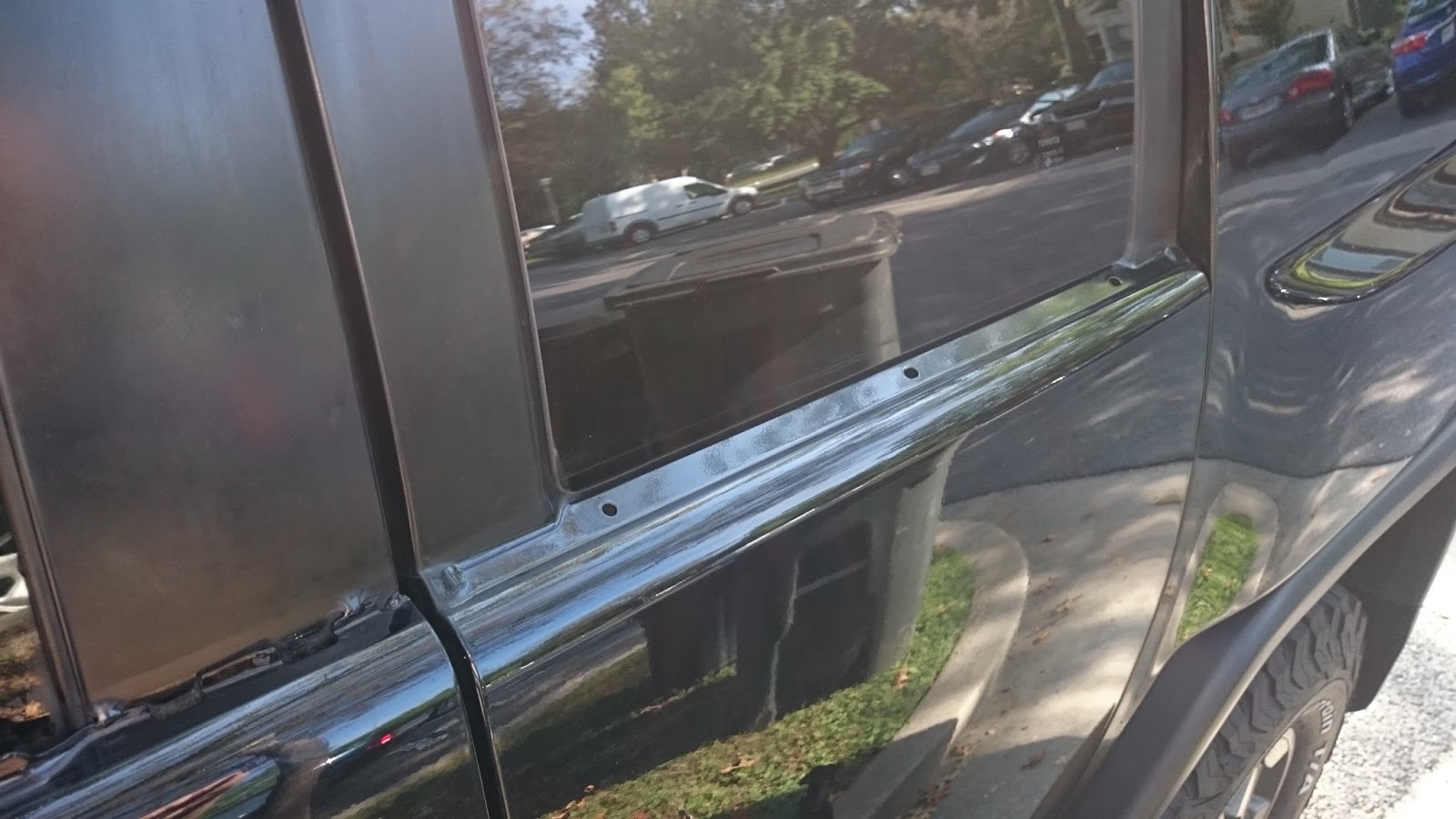
While restoring the black plastic, I noticed that the window trim on the outside of both doors and one of the half-doors was coming apart.  I've never had anything like this happen on other cars that I have owned and learned that the FJ's seem to have this problem.  Since I did not want any water leaking into the door, I decided to order a new set of window trim pieces for all four doors.  Taking them off was fairly simple.  I used a screwdriver, which I had taped with masking tape, and began with the larger door trim.  There are only two places to pop the trim from the brackets that held them in place.  The one in the front was easy to pop off, but the plastic piece fell into the door.  The same happened with the other side.  Since the new trim already had the bracket, I decided that I was not going to take door apart to find it.  I don't think this will cause any issues with the door since the piece is quite small. Once the brackets were taken off, it was hard to pull on the trim and it began tearing.  It seems that you have to push it towards the window and pull up to take it off.  There are a couple of places on the inside of the trim that sticks out to hold it firmly on the door.  Once I had a nice hold of the window trim, I pulled it up while pushing in slightly.  There were about three or four popping noises and the trim was off.

The half door trim was easy enough to take off.  There are three plastic brackets spaced evenly apart, which came right off with the screwdriver.

Once the trims were removed, I cleaned up all the dirt that had accumulated and used touch up paint on any places where the paint was rubbed off during the removal process.  Once dry, I began placing the new trim pieces on the windows.  This was very simple to do and just required aligning the brackets with the holes and pushing down on the trim.  It took about 2-3 mins to place all four trim pieces on the FJ and overall took about 20 mins from start to finish.


Front trim removedRear trim removed


Trim pieces with broken parts and one trim with no issues.

One thing to note is that the trim pieces are different for both sides.  Even though the rear half window trim pieces look exactly the same, they come with different colored plastic brackets.  Pink for the driver side and white for the passenger side.  So make sure that you don't order the same part number twice for both sides.  Each trim piece has their own unique part number.

After replacing the window trim, I installed a set of side visors.  Since I have been driving earlier in the mornings, the sun has been lower and has been an issue with visibility.  I bought some side visors that do not come standard on the 2007 models and installed them as I did in my silver FJ (see earlier post on how to modify and install them).  Since I had done it before, it only took me 10 mins to modify and install them.


Monday, April 25, 2016

D-ring

After being rear ended by a small Honda Civic and my hitch taking most of the force, I decided to get a cheap D-ring on the back in case I get rear ended again. This should give enough space so that my bumper doesn't take any damage the next time that happens.  I surfed the Harbor Freight site and found a hitch insert with the D-ring. The ring is not like the others that you see, which screw into the other side but rather a bolt/nut combination.  The screw had a drilled hole where the pin went into so you dont lose the bolt/nut if it unscrews. Everything looked quite bulky when I bought it so I made some modifications. First I painted the D-ring in red. Once dry, I put it all together and instead of a pin sticking out from the end of the bolt, I used a black zip tie. This seemed to work and the nut/bolt is not going anywhere.  I also had a hitch pin from my old Ridgeline, which I used to hold the D-ring insert in the hitch.  It doesn't look too bad and the reviews on the site said that it is kind of bulky, but it does the job and has never broken. The pin/holder combination is rated for 10,000 lbs.  Not bad for $8!

Wednesday, November 4, 2015

New BF Goodrich KO2s

After 76k miles on the first set of BF Goodrich All Terrain KOs, I needed to get a new set since the rubber was hardening and causing hydroplaning in wet conditions. It was a shame to get rid of them since they still had a nice amount of tread left.  I found an excellent deal at 4wd.com, a shop that specializes in Jeep parts. They had the new BFG KO2s for a ridiculously low price and free shipping. I picked up a set of 5 and had them installed at the local tire shop. These new versions are much better looking than the old ones. They put some tread on the sidewalls, which made them look more like a mud terrain tire.  Once I drove on them it was unbelievable. The ride was much smoother and no vibrations on the steering wheel. On the old KOs it seemed that everywhere I went to get them rebalanced, they had a hard time doing so.  I'm hoping these last another 70+k miles.


Saturday, July 12, 2014

Sony Aftermarket Stereo

After researching many different options for bluetooth streaming, handsfree phone and other options I wanted, I came across the Sony XSP-N1BT.  Apparently it has iPhone connectivity and it uses the phone as the interface for the stereo.  It came with many different options --> CD, Sirius ready, bluetooth and Pandora ready.  Overall, the stereo looks very plain and simple.  Once you add the phone, it is a little more hi-tech.  For the price, I could not find all the features in other units including the add-ons that Toyota provides for the FJammer

First was removing the original FJammer.  This was the easiest part.  First start with the two silver trim pieces on the stereo panel.  There are two screws at the bottom that need to be removed.  Then just place your finger in the depressed area where the screws came out and pull forwards.  The clips at the bottom should come out.  Then use your other hand and pull forward on the top part.  It is very easy to take off.  Just make sure not to pivot from the bottom or you will probably break off the top part.  Everything should be pulled forward.

The next step was to take off the two screws on the sides of the stereo panel (should be color coded to your FJ, mine is black).  They are located at the towards the top on the sides where you took off the silver trim panels.  Take those off and then pull forward from the bottom first then the top.  The clips should pop out easily.

The next step is to take off the four bolts that are holding the stereo in place with the metal brackets.  This was fairly simple.  The stereo then comes out and you disconnect three plugs and the antenna.  The first two plugs are for the power/speakers.  The last plug is for the stereo controls.

I wired up the Sony HU and plugged it in.  I noticed that the stock subwoofer was not working.  After some research, I found a wiring diagram.  Apparently the blue/pink wire on the car harness goes to the subwoofer switch.  Once I connected the remote out wire (blue/white) from the Sony harness, I could use the switch to turn the sub on/off just as if it had the stock HU.

Placing the aftermarket HU in was simple with the Metra install kit.  Just like taking out the FJammer and proceeding with the steps above in reverse.

I was able to pass the microphone through a small gap between the Metra kit and the stereo, so it is just sitting on the bottom right corner.  I didn't want to place it on the dash or the sun visor since it will probably become too hot during the summer.

Overall, the stereo is very nice and can do the following:
1.  Connect any bluetooth device and stream music or sound from movies through the speakers.  In order to play movies through the speakers, you have to connect through bluetooth and not directly through the USB port.
2.  Answering and making calls (can use voice to make a call with the included mic).
3.  Has high rate charging for any device connected to the USB port.
4.  Plays CDs
5.  Has an interface with my iPhone that allows many different features to be set and controlled by an app called Sony App Remote.  You can set your fade/balance with the touch of your finger and it has an equalizer as well.  It recognized different apps on your phone and places them in the Sony app so you don't have to keep switching back and forth.  It recognized Pandora, iHeart Radio, Maps, Motion X drive, and IMDb on my phone.  So I can use the GPS with sound through the stereo.  It will dim all other sound from the stereo when the GPS is speaking.

XM/Sirius is the only option I have not used.

There is also the option to add a rear view camera.  There is an app called RFK WiFi that streams video from a bluetooth camera to your phone.  This will allow you to use the phone, when it is docked in the cradle, as a back-up-camera.  So in essence, you have all the capabilities of a $1000 GPS/DVD unit at a fraction of the cost.  The use of your phone as the stereo interface allows for this cost savings.

Old stereo out and new wiring harness plugged in.

Only uses two of the three plugs.  The other is the control for the steering wheel, which can be added separately.

The subwoofer switch wire is the second from the left (pink/blue)

The Metra harness connects the pink/blue with the blue wire (second from left)

The top is the Metra harness and the bottom is the Sony harness.  The blue/white from the Sony harness needs to be connected to the solid blue on the Metra harness for the subwoofer switch to work.

Everything tested with new HU and final wrap of electrical tape.  Also showing the third plug up on the right in the middle of the picture.  This one is for the steering wheel controls.


The Metra dash install kit is made of plastic.  In order to make sure I did not over tighten and crack the plastic, I added some larger washers to the stock bolts in order to spread the force.  It seemed to hold the stereo in without much movement.


The final result.  Microphone is just sticking out the bottom left corner.  The stereo has the usb on the left with a door.  The CD slot is right in the middle.  There is a top and bottom bar that adjusts depending on what type of phone you have docked.  The top bar moves down and clamps the phone in place to keep it from falling.  There is also a sensor on the bottom bar that turns off the stereo display when a phone is being used.  If you use one of the Sony Android phones(don't remember model), it has a built in connector for charging on the bottom bar.  Using the Sony phone looks much better than using an iPhone since it has a larger display.


Monday, October 7, 2013

Firestik K1A/K4A/K8A

After purchasing the Boztec mount I decided to purchase all the other firestik components that were listed on the Boztec site. This made installation much easier than using the old coax cable that was somewhat short. With the 18' cable I was able to pass it from the back along the side of the rear seat and run it through the channel along the door. I then passed it underneath the front seat and out through the hole where the air bag sensor connector goes through. I was able to place the extra 3' of coax into the center console where I had the CB.  The other side of the coax went into the firestik k1a connector which was easy enough to mount and tighten to the boztec mount. The spring then went on top.  After installing, I thought about buying a quick release so that I could easily take off the antenna whenever I wanted to. It added about 3 more inches to the stack of connector and spring. Once everything was connected, I hooked up the SWR and saw that there was no reflection whatsoever for ALL channels. The power output of the CB was also a full 4 Watts. I think using the quick disconnect raised the antenna enough above the roofline to optimize transmission without any reflections. I was impressed with this setup.  Next, I might buy an SSB/CB combo unit. I've seen quite a few nice ones out there with some having built-in SWR.

Update - After 3 years of keeping the antenna on the FJ, it looks like the quick release does not work anymore since the internals had rusted.  I could tell from the rust coming out of the small circular pin on the outside.  I have read that others have had the same problem and that they use dielectric grease after purchasing in order to keep it from rusting.  I think if Firestik had used stainless steel internals it would still be working.  So now it's just an extender to the antenna and I have to use a wrench to take it off, which is pointless for a quick release.  Everything else seems to be aging well without rusting and the FJ is kept outside all the time.  I didn't even have to tune the CB after a couple of years that it was unused and disconnected.

CB antenna stack - Boztec mount, connector, spring, quick disconnect, 5' antenna. 

Tuesday, October 1, 2013

Boztec CB mount

My handmade mount was not standing up to the weight if the antenna and spring. I decided to buy a Boztec mount after reading up on it. I also gave Boztec a call to discuss the difference between the HAM and CB mounts. Apparently the owner gave me a call back!  After discussing the differences I went with the CB mount. I also ordered a new cable and connector. I was impressed at the thickness and quality of the mount.

Once it was all hooked up it looked like this -
                         Boztec mount with logo.

It was a very easy install. I mounted the cable and connector prior to placing on the FJ.  In order to get a good ground connection I sanded the back side of the mount and connected a wire that I grounded to the chassis where the jack is located.  I didn't want to sand the paint off the FJ, so grounding with the wire prevented this. 
Next was tuning. I hooked up the SWR meter and looked at the results. It was a little high at 2.5 but I had forgotten that I screwed in the tip all the way when I took it off. So after tuning the tip I obtained the same SWR as I had with my original setup - 1.5 on ch 1 and almost no reflection on ch. 40.


Driver's seat falling apart!

After noticing a small hole in the back of the driver's seat, I didn't pay much attention to it. When a bag snagged a "wire" and ripped through the vinyl, I noticed!  I went to the local Toyota dealership and they looked at it and said it wouldn't be covered under my extended warranty since its considered damage!  They also stated that I would have to take it to an upholstery shop to get it fixed.  It seems that I wasn't going to get anywhere with them.  I decided to investigate and took the cover off by first unhooking the straps under the seat, taking off the three yellow rings at the bottom and then the two holding the zippers.  This is what I found - 

               Rip through vinyl. 

      Rip again without spring sticking out. 

                  Broken spring!

Broken spring hooked to white plastic piece that didn't keep it in place since there was no tension anymore. 

      Yellow metal rings holding zipper.

            Zipper on right side.

I couldn't believe that a spring had failed. No bend or anything. Seeing that it was dangerous to have a loose spring that someone in the back seat could hurt themselves on, I tried to take the spring off. This wire was extremely hard to bend  and I tried to cut it with no success so I bent it into one of the holes on the side of the seat so that it wouldn't jiggle around. This certainly is a case of metal fatigue!  It makes me worry what other things might happen at a later date. 

So once I bent it back, I decided to look at another issue I had since I bought it - a hole in the foam on the left side where you rub up against entering and exiting. I was able to put my hand through and feel around. All I felt was metal. I had to go and buy some upholstery filler and fill the hole. This made it so that the fabric was no longer in a situation where a hole might tear through it after continuous use of the seat. I've read that a lot of FJs have this problem.

I also had a creaking noise when I bought it but I didn't investigate this issue since I assumed it's probably due to the chair being used for 6 years. 

I decided to repair the slit myself. It didn't turn out very well, but at least the rip won't become larger.  I also contemplated seat covers but it was too expensive for the ones I liked. I did see a few people selling their OEM covers but that was even more expensive since they included all the seats.  I might reconsider at a later time but, for now, it will have to do. 

Overall, I'm not impressed with Toyota quality.  I've hade much cheaper cars for much longer without these kind of issues on the seat.